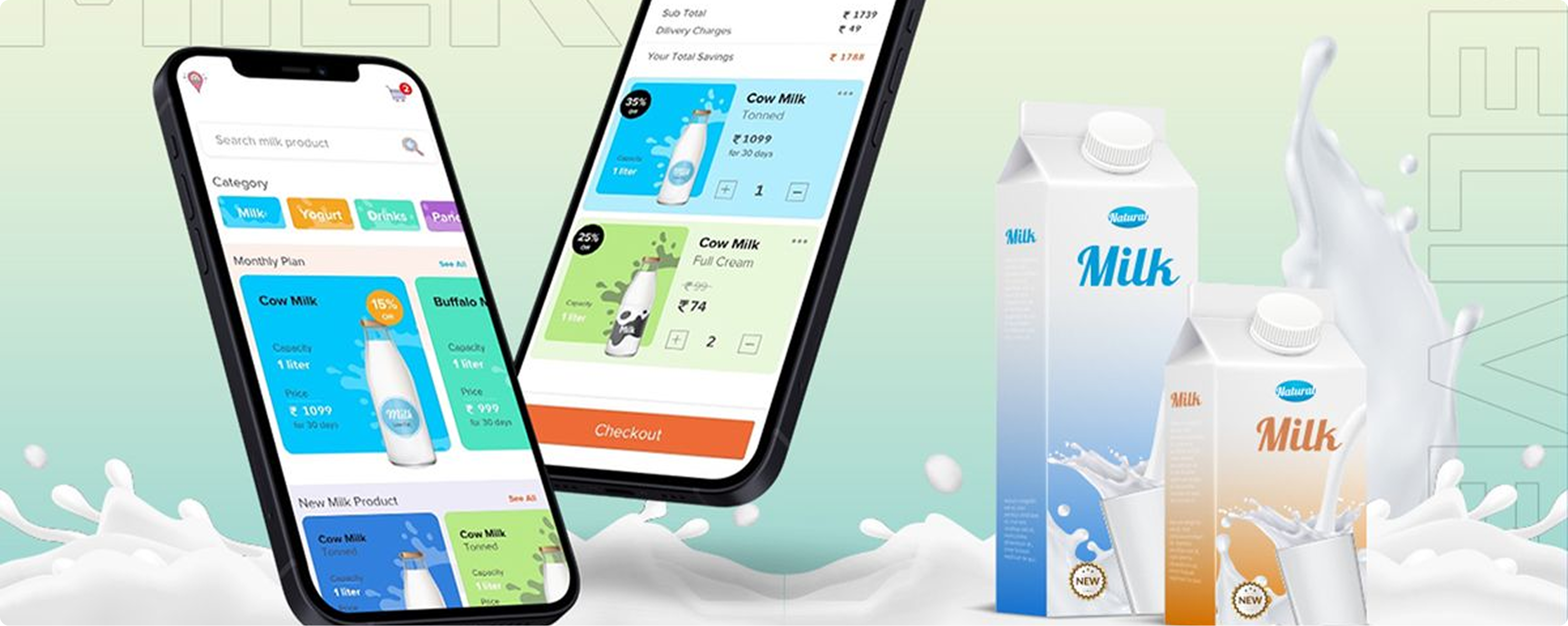
Milk Delivery App Development in India: Features, Cost, and Everything You Need to Know
In this article
Milk Delivery App Development in India: Features, Cost, and Everything You Need to Know
The Market Opportunity Behind Milk Delivery App Development in India
Types of Milk Delivery Apps You Can Build
Key Features of a Milk Delivery App
AI Powered Features That Make Milk Delivery Apps Smarter in 2026
Recommended Tech Stack for Milk Delivery App Development in 2026
Should You Build Custom, Buy a SaaS, or Go White Label?
How the Milk Delivery App Development Process Works Phase by Phase
Milk Delivery App Development Cost in India [2026]
Legal and Compliance Requirements for Milk Delivery Apps in India
Popular Milk Delivery Apps in India Worth Studying
How to Choose the Right Milk Delivery App Development Company in India
Unlock how AI can transform your business in just one call
CONTACT US
Why Milk Delivery Apps Are Booming in India Right Now
India is the world's largest milk producer, contributing over 230 million tonnes annually to global dairy output. Yet despite this scale, nearly 70 percent of Indian dairies still rely on manual delivery routes, paper order books, and cash collected at the doorstep each morning. That gap between production scale and operational maturity is precisely where milk delivery app development creates its most compelling business case.
The organised dairy tech market in India is growing at over 20 percent CAGR, driven by three simultaneous forces. The post-COVID shift to home delivery subscriptions has proved permanently sticky. UPI penetration has made cashless subscriptions effortless for consumers across income segments. And the precedent set by brands like Country Delight, Milkbasket, and Supr Daily has demonstrated that a scalable, funded business can be built entirely on the back of a purpose built delivery app.
For dairy owners, distributors, and entrepreneurs, 2026 is the most compelling window to go digital. Consumer behaviour is established, the infrastructure is ready, and a significant portion of the addressable market has still not moved online. This guide covers everything you need to build a milk delivery app that works in the Indian market.
The Market Opportunity Behind Milk Delivery App Development in India
The Indian dairy industry is valued at over 16 lakh crore rupees and is the single largest agricultural commodity sector in the country. Within this, the organised home delivery segment is growing faster than the broader market, propelled by urban consumers willing to pay a premium for consistency, quality assurance, and convenience.
Two distinct business models are shaping milk delivery app development in India today. The first is the single dairy app, where one brand delivers directly to its own subscribers. Local creameries, regional dairies, and brands like Mother Dairy use this model to own their customer relationships completely. The second is the aggregator or marketplace model, where a single platform connects multiple dairy brands to consumers in one unified experience. This is the approach Milkbasket pioneered before its acquisition by Reliance.
The Tier 2 and Tier 3 city opportunity remains almost entirely untapped. Competitors in this space focus their case studies almost exclusively on metro markets. Yet cities like Lucknow, Indore, Coimbatore, and Rajkot have dense milk consumption habits, reliable smartphone penetration, and virtually no organised digital dairy platform serving them. For entrepreneurs looking for white space, this is where the next generation of milk delivery app success stories will emerge.
Types of Milk Delivery Apps You Can Build
Before commissioning any development, understanding which app model fits your business is essential. There are four distinct categories, each with a different complexity level and launch timeline.
Single Dairy App: One brand delivers directly to its own subscribers. Fastest to build, easiest to maintain. Ideal for local dairies going digital for the first time.
Aggregator or Marketplace App: Multiple dairy brands connect to consumers through one platform. Higher complexity and operational requirement but significantly larger addressable market.
Subscription Box App: Premium model built around curated dairy bundles. Strong margins, urban consumer focus, and a brand storytelling opportunity around farm origin and quality.
B2B Dairy Distribution App: Dairy supply flowing from producer to retail shops rather than directly to consumers. Solves a different problem but operates on similar technical architecture.
Key Features of a Milk Delivery App
Every competitive milk delivery app operates across three panels. The customer app, the admin dashboard, and the delivery agent interface must all work in sync for the platform to run reliably at scale.
Customer App Panel
Subscription Scheduling: Daily, alternate day, and weekly delivery options with the ability to pause and resume without contacting support. This single feature drives retention more than any other.
Real Time Delivery Tracking: Live map view showing where the delivery agent is and the estimated arrival time. Eliminates the most common customer support query.
In App Wallet and Payments: UPI, card, and wallet support built in. Subscription auto billing through standing instructions removes friction from the renewal cycle entirely.
Product Catalog with Variants: Full cream, toned, A2, and flavoured milk with clear variant differentiation. Consumers in the premium segment make purchasing decisions based on product detail.
Push Notifications: Delivery confirmations, wallet balance alerts, and promotional offers. Notification strategy directly impacts subscription renewal rates.
Order History with One Tap Reorder: Reduces the effort required to restart a paused subscription. Every additional tap in the reorder flow costs conversions.
Admin Dashboard Panel
Centralised Order Management: Real time view of all active orders, their status, and any exceptions. The operations team lives in this panel every morning.
Delivery Zone and Pincode Configuration: Control over which areas the service covers and what delivery windows apply to each zone.
Subscription Overview: A complete view of every active, paused, and lapsed subscription across the customer base. The most important retention management tool in the admin panel.
Revenue Analytics and Reports: Daily, weekly, and monthly revenue reporting with export functionality for accounting and GST filing.
Inventory and Low Stock Alerts: Automated triggers that flag when stock levels fall below the threshold required for the next morning's deliveries.
Driver Assignment and Route Management: Manual override capability for the operations team on top of automated route optimisation.
Delivery Agent Panel
Optimised Daily Route View: Sequenced stop order based on geography and delivery windows. The agent opens the app each morning and follows the sequence.
Order Completion with Proof: OTP verification or photo proof of delivery. Both protect the business against false non-delivery complaints.
Earnings and Attendance Tracker: Agents can see their daily and monthly earnings in real time. Transparency here directly reduces agent churn.
Offline Mode: Critical for delivery zones with poor connectivity. The app must function without a live internet connection and sync when connectivity returns.
AI Powered Features That Make Milk Delivery Apps Smarter in 2026
This is the section that separates genuinely forward thinking milk delivery platforms from the dozens of functionally identical apps built over the past decade. Not one competitor currently ranking for this keyword addresses AI capabilities in any meaningful way. That gap represents both a product opportunity and a content differentiation advantage.
AI Route Optimisation: Dynamic routing based on real time traffic data, weather conditions, and order density. Logistics platforms report this approach reduces fuel costs by 20 to 30 percent and cuts average delivery time per stop. For a dairy operation running 50 or more deliveries per agent per day, the cumulative savings are substantial across a full year of operations.
Demand Forecasting: Machine learning applied to historical subscription data, seasonal patterns, and local events to predict tomorrow's required stock with far greater accuracy than manual estimation. Dairy products have a short shelf life. Overstocking results in direct financial loss and AI forecasting reduces that wastage meaningfully over time.
Smart Reorder Nudges: Behavioural signal detection that identifies when a subscriber has paused for more than three days or reduced order frequency, then automatically triggers a personalised win back notification before the subscription lapses entirely.
Chatbot Powered Customer Support: Instant resolution for the most common queries including delivery delays, subscription modification requests, and wallet top up issues. Reduces support team workload by handling the high volume low complexity tier of customer queries automatically.
Freshness Tracking via IoT Integration: For premium urban dairies, IoT sensors paired with an AI analysis layer provide end to end cold chain visibility. This feature justifies premium pricing when the quality story is made transparent and verifiable to consumers.
The tech stack enabling these capabilities includes Google Maps Platform for routing optimization, TensorFlow Lite for on-device inference, and OpenAI APIs for conversational customer support layers.
Recommended Tech Stack for Milk Delivery App Development in 2026
Selecting the right technology stack determines your app's performance, scalability, and long term maintenance cost.
| Layer | Recommended Technology |
|---|---|
Mobile Frontend | Flutter (recommended), React Native |
Web Admin Panel | React.js, Next.js |
Backend | Node.js, Python FastAPI or Django |
Database | PostgreSQL, MongoDB |
Real Time Tracking | Google Maps API, Mapbox |
Push Notifications | Firebase Cloud Messaging |
Payments | Razorpay, PayU, Cashfree |
AI and ML Layer | TensorFlow, OpenAI API |
Cloud Hosting | AWS, Google Cloud Platform |
DevOps | Docker, Kubernetes |
Why Flutter for Indian Dairy Apps
Flutter produces a single codebase running natively on both Android and iOS. The dominant device category among Indian dairy consumers is mid range Android. Flutter's performance on these devices is particularly well optimised and the single codebase results in meaningfully lower development cost compared to maintaining two separate native builds. For Indian market pricing and timelines, Flutter is the right starting point for most dairy app projects.
Why Indian Payment Gateways
Razorpay, PayU, and Cashfree support UPI natively, which is the primary payment method for daily subscriptions across Indian markets. International gateways such as Stripe are not the right fit for this use case. Your payment layer should be built for the way Indian consumers actually pay, not for how Western markets pay.
Should You Build Custom, Buy a SaaS, or Go White Label?
This is the fundamental decision every dairy owner or entrepreneur must make before engaging a development partner. It is a question that no competitor currently ranking on page one answers directly.
| Option | Best For | Cost INR | Launch Time |
|---|---|---|---|
Custom Development | Scaling dairies, unique workflows | 8 lakh to 25 lakh | 3 to 6 months |
White Label App | Startups, fast launch | 1.5 lakh to 4 lakh | 2 to 4 weeks |
SaaS Platform | Small dairies, low budget | 500 to 2000 per month | 5 to 10 days |
Choose Custom Development if your dairy processes 500 or more daily orders, requires aggregator functionality connecting multiple vendors, or has workflows a generic platform cannot accommodate. Custom development gives you source code ownership, unlimited configurability, and no recurring platform fees once the build is complete.
Choose a White Label App if you are an entrepreneur or small dairy looking to launch within weeks rather than months. You get a working product at a fraction of the custom development cost and can upgrade to a fully custom build once your subscription model has been validated in the market.
Choose a SaaS Platform if you are a single dairy with under 200 daily orders and want to go digital with minimal upfront investment. The monthly cost is predictable, support is included, and it is the right starting point for dairies testing digital operations before committing to a larger build.
How the Milk Delivery App Development Process Works Phase by Phase
Understanding what happens at each stage of development helps you evaluate agency proposals accurately and set realistic expectations for your team.
| Phase | What Happens | Duration |
|---|---|---|
Discovery and Scoping | Requirements, wireframes, tech decisions | 1 to 2 weeks |
UI/UX Design | App screens, admin panel, user testing | 2 to 3 weeks |
Development | Frontend, backend and API integrations | 8 to 14 weeks |
QA and Testing | Device, load and payment testing | 2 to 3 weeks |
Launch and Deployment | App Store, Play Store, server setup | 1 to 2 weeks |
Post Launch Support | Bug fixes, performance monitoring | Ongoing |
The discovery and scoping phase is the most critical and the most frequently rushed. Decisions made during requirement gathering, specifically around subscription logic, delivery zone rules, and payment flows, shape every subsequent phase. A development partner who abbreviates discovery is one who will bill you for change requests throughout the build.
Milk Delivery App Development Cost in India [2026]
Cost is the question every buyer asks and the one no competitor currently answers directly in Indian rupees.
| App Tier | Features Included | Estimated Cost INR |
|---|---|---|
Basic MVP | Customer app and admin panel | 3 lakh to 6 lakh |
Standard | 3 panels, subscriptions, GPS tracking | 8 lakh to 15 lakh |
Advanced | AI features, aggregator model | 18 lakh to 30 lakh |
Enterprise | Full custom with dedicated support | 35 lakh and above |
Factors That Push Cost Higher
Building for both Android and iOS simultaneously adds 20 to 30 percent to the base cost compared to Android only development. Integrating AI features including route optimisation and demand forecasting adds significant backend complexity. A fully custom designed admin dashboard costs more than one assembled from a standard component library.
Maintenance Cost
Post launch maintenance typically runs at 15 to 20 percent of the original build cost annually. This covers server costs, third party API subscriptions, OS update compatibility, and ongoing bug fixes. Factor this into your total cost of ownership when comparing development options.
Legal and Compliance Requirements for Milk Delivery Apps in India
Compliance is a topic completely absent from every competitor currently ranking for this keyword. Yet for a dairy entrepreneur in India, these requirements are real, consequential, and non negotiable from day one.
FSSAI Registration or License
Any business handling, distributing, or facilitating the sale of dairy products in India must hold a valid FSSAI registration or license depending on annual turnover. The category varies from basic registration for small producers to a central license for businesses operating across multiple states. Your app's onboarding flow and business documentation must reflect the appropriate FSSAI credential.
GST Integration
Dairy products carry differentiated GST slabs. Fresh milk is exempt but flavoured milk, paneer, and value added dairy products attract varying rates. Your billing engine must apply the correct rate at the product level, not a flat percentage applied across the entire catalog.
DPDP Act 2023 Compliance
The Digital Personal Data Protection Act of 2023 governs how your app collects, stores, and processes customer data including delivery addresses, phone numbers, and purchase history. Explicit consent at onboarding, a clear privacy policy, and data minimisation principles are all mandatory under this framework.
PCI DSS for Payments
Using Indian payment gateways like Razorpay handles PCI DSS compliance for card data automatically, removing the most complex piece of payment security from your direct responsibility.
Popular Milk Delivery Apps in India Worth Studying
Country Delight built its brand entirely on a farm to door narrative and an app experience that makes the supply chain visible and verifiable to the consumer. Its strength is trust built through origin transparency. The lesson for new entrants is that premium pricing is sustainable when the app experience makes the quality story tangible at every touchpoint.
Milkbasket pioneered the zero friction subscription model in India, where a consumer sets a daily order once and the app handles everything from billing to doorstep delivery without requiring any further interaction. Its acquisition by Reliance validated the unit economics of this model at scale. If you are building an aggregator platform, Milkbasket's subscription management experience is the benchmark to study.
Supr Daily, operating under the Swiggy network, leveraged an existing delivery infrastructure to add daily essentials including milk to a base of food delivery customers. The takeaway is that distribution infrastructure matters as much as the app itself, and a partnership with an existing logistics provider can significantly reduce the cost and timeline of reaching scale.
How to Choose the Right Milk Delivery App Development Company in India
The difference between a successful launch and a stalled one often comes down to the development partner rather than the idea itself. Before signing any engagement, evaluate every shortlisted agency against these criteria.
Portfolio Evidence: At least one live on demand or delivery app in their portfolio, not just mockups or wireframes presented in a sales deck.
Indian Payment Gateway Experience: Specific experience integrating Razorpay or PayU, not just generic payment gateway work.
FSSAI Awareness: The ability to build compliant onboarding flows and advise on how license type affects the app's business flow.
Post Launch Support in Writing: Support commitment written into the contract, not verbal assurance given during the sales conversation.
Source Code Ownership: Full source code transferred to you at project completion with no ongoing dependency on the agency to make changes.
Subscription Billing Experience: Subscription billing logic is considerably more complex than standard ecommerce checkout. Ask to see a live example of subscription management they have built.
Ask specifically for references from clients in the food, grocery, or daily essentials delivery space. An agency that has built a laundry pickup or salon booking app brings relevant mobile experience but has not confronted the operational complexity of daily subscription delivery at scale. That distinction matters more than headline team size or years of general experience.
FAQs
Yes, you can build your own milk delivery app by hiring a development company, using a white label solution, or subscribing to a SaaS platform. For Indian dairies processing 200 or more daily orders, custom development offers the most control over subscriptions, delivery routes, and overall brand experience.
Popular milk delivery apps in India include Milkbasket, Country Delight, and Supr Daily. If you want a branded app for your own dairy rather than listing on a marketplace, a custom or white label solution gives you full control over pricing, subscriptions, and direct customer relationships.
Milk delivery app development in India costs between 3 lakh and 30 lakh depending on features, platforms, and number of panels. A basic MVP starts at 3 to 6 lakh while a full featured app with GPS tracking, AI capabilities, and three user panels typically ranges between 10 lakh and 25 lakh.
Starting a milk delivery business involves securing an FSSAI licensed dairy source, defining your delivery zone and subscription model, building or buying a milk delivery app, and setting up a delivery fleet. A subscription first model with daily auto billing typically generates the most stable and predictable recurring revenue for new operators.
A basic milk delivery app takes 8 to 12 weeks to build. A standard three panel app with subscriptions, GPS tracking, and payment integration typically takes 14 to 20 weeks. Timeline depends on feature complexity, number of platforms targeted, and whether you choose custom development or a white label solution.
Yes. Any business facilitating the sale of dairy products in India must hold a valid FSSAI license. Your app should also integrate GST compliant billing and follow the DPDP Act 2023 for customer data. Using Indian payment gateways like Razorpay ensures PCI DSS compliance without additional technical overhead.