
Why Most Custom Machine Learning Solutions Fail Before Launch (And How to Get It Right)
In this article
Why Most Custom Machine Learning Solutions Fail Before Launch (And How to Get It Right)
The Reality of the AI Explosion
Why Generic AI Tools Break at Scale
The PRECISION AI Framework: A Smarter Way to Think About Custom ML
Where Custom Machine Learning Solutions for E-commerce Win Big
How to Evaluate a Custom Machine Learning Solutions Provider
Custom vs. Pre-Built AI: The Real Comparison
What Actually Worked: A Real-World Example
Your Implementation Roadmap
Future Outlook: The "Tailored Intelligence" Era
Unlock how AI can transform your business in just one call
CONTACT US
Most businesses don’t fail at AI because of bad technology they fail because they choose the wrong type of machine learning solution. We’ve seen it happen repeatedly: a company buys a shiny, pre-packaged AI tool, plugs it in, and realizes six months later that it doesn't understand their specific customer nuances or supply chain quirks.
If you're still relying on plug-and-play AI tools in 2026, you're already behind the curve. While generic models are great for basic tasks, they lack the "DNA" of your specific business operations. That’s where custom machine learning solutions step in to bridge the gap between "cool tech" and "actual ROI."
If you’re exploring scalable AI systems, partnering with an experienced AI development team can dramatically reduce failure rates and ensure your data actually moves the needle.
The Reality of the AI Explosion
We are currently in an era where everyone "has AI," but very few are actually winning with it. According to recent Gartner reports, the mismatch between generic tools and niche business needs is the primary reason projects stall.
Think of it like buying a suit. You can get one off the rack that fits "well enough," or you can go to a tailor who measures your exact build. In the world of high-stakes data, "well enough" usually leads to inaccurate predictions and wasted cloud spend.
Why Generic AI Tools Break at Scale
One-size-fits-all models have a ceiling. We’ve tested several "enterprise-ready" SaaS AI platforms and found a recurring pattern: they struggle with domain-specific learning. If you are in a niche like medical diagnostics or high-frequency trading, a generic model lacks the context to be precise.
These tools often suffer from:
Data Rigidity: They expect your data to look a certain way.
Poor Integration: They don't "talk" to your legacy ERP or CRM systems effectively.
Black Box Logic: You can't see why the model made a specific decision.
In short, when you use a generic tool, you are adapting your business to the software. With custom machine learning & AI solutions, the software adapts to you.
The PRECISION AI Framework: A Smarter Way to Think About Custom ML
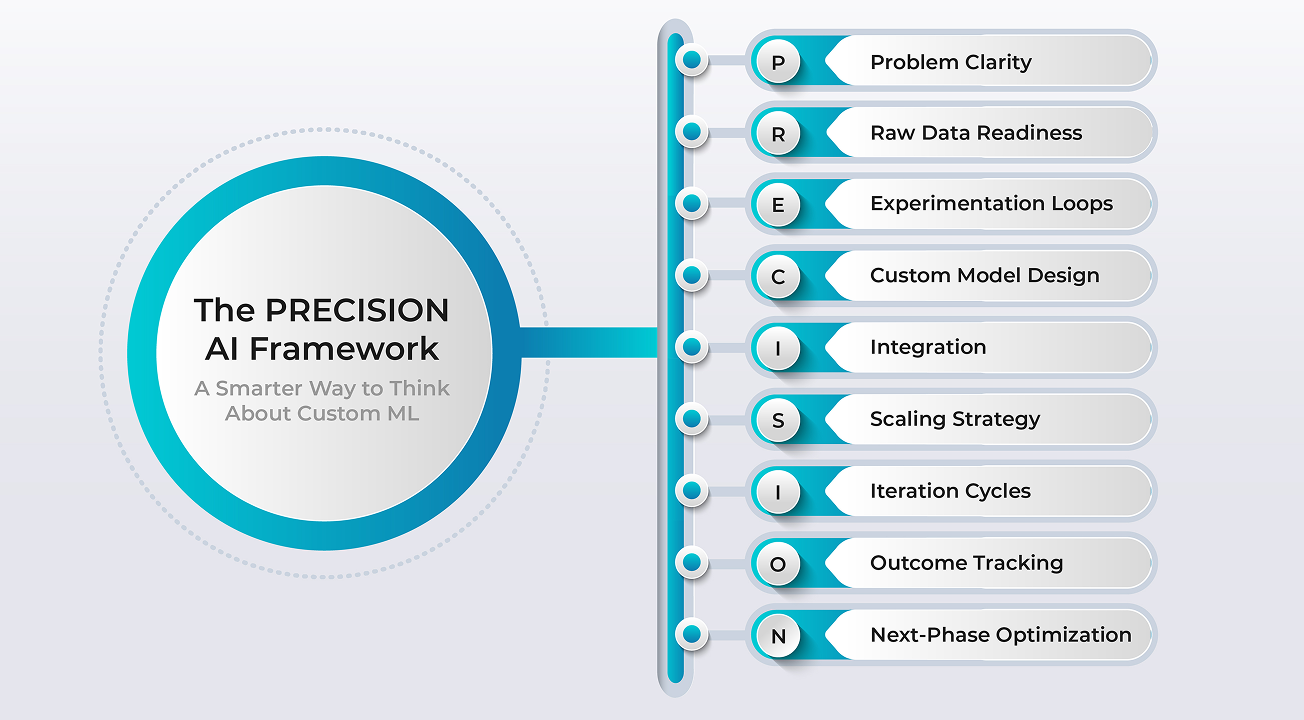
To avoid the common pitfalls of AI implementation, we use a specific mental model called the PRECISION AI Framework™. This ensures that every model we build isn't just a piece of code, but a revenue engine.
P – Problem Clarity: What specific pain point are we solving? (e.g., "Reduce churn by 15%").
R – Raw Data Readiness: Is your data clean, or is it a "data swamp"?
E – Experimentation Loops: Testing small, failing fast, and refining.
C – Custom Model Design: Choosing the right architecture (Neural Networks, Random Forests, etc.).
I – Integration: Making sure the AI lives where your team actually works.
S – Scaling Strategy: Preparing for 10x the data volume without 10x the cost.
I – Iteration Cycles: AI is never "done"; it needs to learn from new patterns.
O – Outcome Tracking: Measuring $ signs, not just "accuracy scores."
N – Next-Phase Optimization: What’s the next bottleneck the AI can solve?
Where Custom Machine Learning Solutions for E-commerce Win Big
Let’s talk about a sector that lives and dies by its data: E-commerce. If you're running a high-volume store on Shopify or Adobe Commerce, a generic recommendation engine is a missed opportunity.
We found that custom machine learning solutions for e-commerce outperform standard plugins by nearly 35% in conversion rate. Why? Because a custom model can factor in real-time inventory, local weather patterns, and even individual user "click-fatigue" levels.
Dynamic Pricing Engines are another goldmine. Instead of flat discounts, custom ML analyzes competitor pricing and your margins to find the "sweet spot" price point for every single visitor in real-time.
How to Evaluate a Custom Machine Learning Solutions Provider
Not all AI shops are created equal. When you're looking for the best AI development companies for custom machine learning solutions in 2026, don't just look at their tech stack. Look at their business logic.
Here is what actually matters:
Domain Expertise: Do they understand your industry's specific regulations (like GDPR or HIPAA)?
Data Engineering: Can they actually clean your data, or do they expect you to do it?
Model Explainability: Can they explain why the AI recommended a specific action?
Post-Deployment Support: AI drifts over time. Who is monitoring it at 3 AM?
Custom vs. Pre-Built AI: The Real Comparison
| Factor | Pre-Built AI Tools | Custom ML Solutions |
|---|---|---|
Flexibility | Low (Rigid templates) | High (Built for your goals) |
Initial Cost | Low to Medium | Medium to High |
Long-term ROI | Limited (Plateaus quickly) | High (Compounding value) |
Scalability | Restricted by API limits | Fully scalable and owned by you |
Data Privacy | Shared or Hosted | Fully private and secure |
What Actually Worked: A Real-World Example
One of our clients, a B2B logistics company, was using a third-party demand forecasting tool that had a 22% error rate on weekly volume predictions. That doesn't sound terrible until you realize it was causing consistent over-staffing and $40K in monthly overtime costs.
We rebuilt their forecasting model from scratch using their historical shipment data, route-level patterns, and external variables like weather and fuel pricing.
Result: error rate dropped to under 8%. Monthly savings exceeded the entire project cost within four months.
The difference wasn't magic. It was Experimentation loops running multiple model architectures, testing against real operational data, and iterating before going live. That's PRECISION AI in action.
Your Implementation Roadmap
If you’re ready to move beyond the "AI hype" and into actual implementation, follow this roadmap based on our framework:
1. Audit Your Data
Don't build a house on sand. You need to know what data you have, where it lives, and how "noisy" it is.
2. Define the North Star Metric
Don't just say "we want AI." Say "we want to reduce customer support tickets by 20% using a custom NLP classifier."
3. Build the MVP (Minimum Viable Predictor)
We always recommend starting with a pilot. Test the custom model on a subset of data to prove the ROI before going "all in."
4. Deploy and Iterate
Once it’s in the wild, the real work begins. Monitor the feedback loops and refine the model weekly.
Future Outlook: The "Tailored Intelligence" Era
As we move deeper into 2026, the gap between companies that "use AI" and companies that "own their AI" will widen. Competitive advantage will no longer come from using the same LLMs as everyone else; it will come from the proprietary, custom-trained models that live inside your organization.
Think of custom ML as your company’s "Digital Brain." It’s an asset that grows more valuable every day it's in operation.
FAQs
Most production-ready MVPs take between 3 to 6 months. This includes data cleaning, model training, and integration.
Initially, yes. However, when you factor in the lack of monthly per-user fees and the significantly higher ROI from accuracy, custom solutions usually pay for themselves within 12-18 months.
No. Many companies partner with a [Internal Link: Custom software development] firm to act as their "Fractional AI Department."
In 99% of cases, yes. The beauty of custom solutions is that we build the "connectors" to work with whatever legacy systems you currently use.