Custom AR/VR Game Development: Complete Guide to Building Immersive Experiences in 2026
In this article
Custom AR/VR Game Development: Complete Guide to Building Immersive Experiences in 2026
What is Custom AR/VR Game Development?
Why Invest in AR/VR Development Services?
The Custom AR/VR Game Development Process
Essential Technologies for AR/VR Game Development
Understanding AR/VR Game Development Costs
Common Challenges and Practical Solutions
Conclusion
Unlock how AI can transform your business in just one call
CONTACT US
The gaming industry is experiencing a paradigm shift as custom AR/VR game development revolutionizes player engagement and interaction. With the global AR/VR market projected to reach $250 billion by 2028, businesses and game studios are increasingly investing in professional ar/vr development services to create unique, immersive experiences.
Custom AR development and VR development go far beyond traditional game development, offering interactive storytelling, realistic simulations, and engaging gameplay that captivates modern audiences. Whether you're developing an educational training platform, entertainment-focused VR adventure, or location-based AR game, understanding the nuances of custom AR/VR game development is essential for success.
This comprehensive guide explores the fundamentals, development process, costs, and strategic benefits of AR/VR gaming, helping you make informed decisions about your next immersive project.
What is Custom AR/VR Game Development?
Defining AR and VR Game Development
Augmented Reality (AR) game development overlays digital content onto real-world environments, allowing players to interact with virtual elements through smartphones, tablets, or AR glasses. Games like Pokémon GO and AR escape rooms have demonstrated the massive potential of this technology. Key platforms powering AR experiences include ARKit for iOS devices, ARCore for Android, and Vuforia for cross-platform marker-based tracking. AR games blend physical and digital worlds, creating unique location-based experiences that encourage outdoor exploration and social interaction.
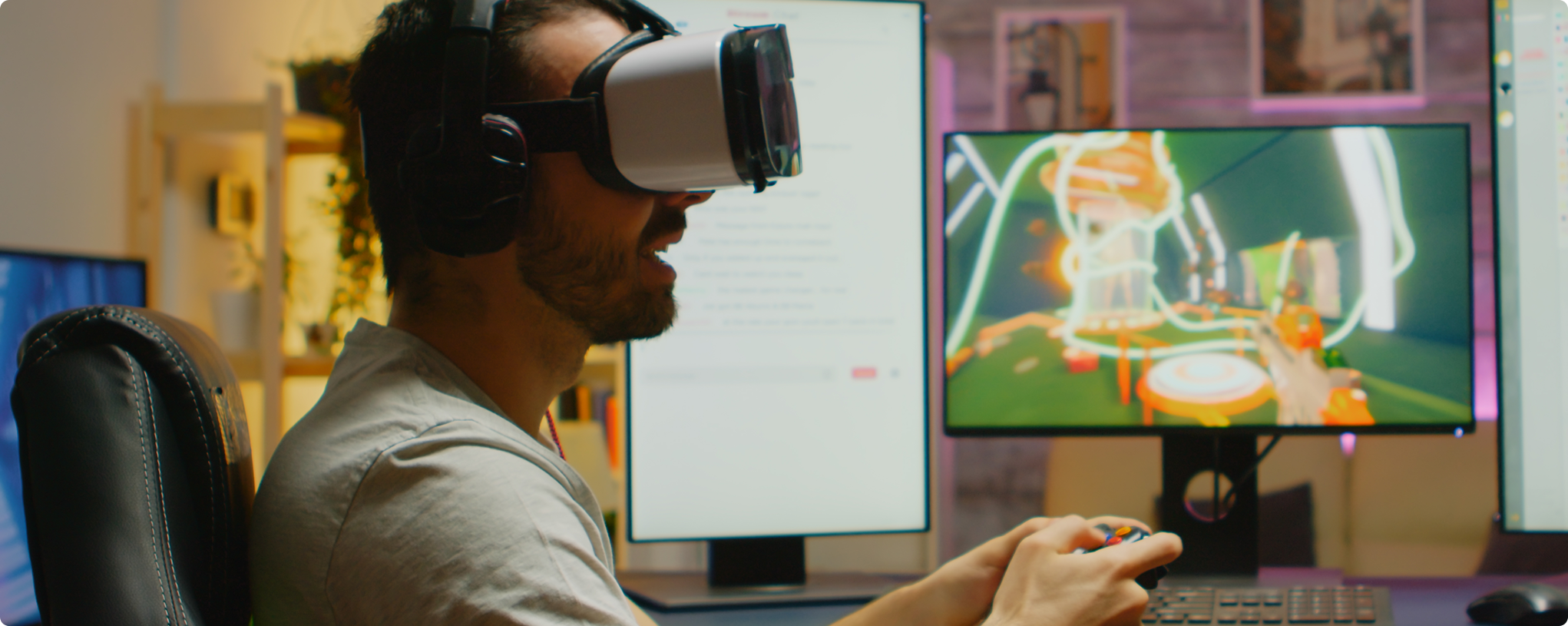
Virtual Reality (VR) game development, on the other hand, creates completely immersive 3D digital environments accessed through VR headsets like Meta Quest, PlayStation VR, and Valve Index. Popular titles such as Beat Saber, Half-Life: Alyx, and Rec Room showcase VR's ability to transport players into fantastical worlds. VR development leverages platforms like Oculus SDK, SteamVR, Unity XR, and Unreal VR to deliver 360-degree experiences with spatial audio and intuitive hand-tracking controls.
The Custom Development Advantage
While template-based solutions offer quick deployment, custom AR/VR game development provides tailored gameplay mechanics aligned with your brand identity, unique user experiences that differentiate from competitors, and scalable architecture for future feature additions. Custom solutions ensure seamless integration with existing business systems, platform-specific optimization for superior performance, and full intellectual property ownership critical factors for long-term success in the competitive gaming landscape.
Why Invest in AR/VR Development Services?
Unmatched User Engagement
The immersive nature of AR/VR technology drives unprecedented engagement metrics. Studies show 70% higher retention rates compared to traditional games, while immersive 360-degree environments create emotional connections that increase brand recall by 85%. Players don't just watch content they experience it, leading to deeper investment in gameplay and stronger community building.
Diverse Industry Applications
AR/VR game development extends far beyond entertainment. In education and training, medical schools use VR simulations for surgical practice, while corporations leverage VR for safety training and skill development. Healthcare applications include physical therapy games, mental health treatment through exposure therapy, and pain management through distraction techniques. Real estate professionals offer virtual property tours and architectural visualizations, while retail and e-commerce brands implement virtual try-ons and interactive product demonstrations. Marketing teams create memorable brand activations and experiential campaigns that leave lasting impressions.
Multiple Revenue Streams
AR/VR games unlock diverse monetization opportunities. Premium game sales generate direct revenue, while in-app purchases and microtransactions provide ongoing income streams. Subscription-based models offer recurring revenue for continuous content access. Enterprise B2B licensing for training solutions commands premium pricing, and advertising partnerships in free-to-play AR games reach massive audiences. Forward-thinking developers are even exploring NFT integration and virtual asset sales in the emerging metaverse economy.
The Custom AR/VR Game Development Process
Phase 1 - Discovery and Strategy
Successful AR/VR projects begin with thorough planning. Initial consultations establish clear requirements and objectives, while target audience analysis ensures the game resonates with intended players. Platform selection whether mobile AR, standalone VR, PCVR, or WebXR impacts every subsequent decision. Creating a comprehensive game design document (GDD) establishes the creative vision, technical specifications, and project roadmap. Technical feasibility assessments identify potential challenges early, preventing costly mid-project pivots.
Phase 2 - Design and Prototyping
The design phase transforms concepts into tangible assets. Concept art establishes visual style, while storyboarding maps narrative progression and key gameplay moments. 3D artists create character models and environment assets, and UI/UX designers craft intuitive interfaces optimized for immersive spaces. Interactive prototypes allow stakeholders to experience core mechanics firsthand. User testing at this stage identifies friction points before significant development resources are committed, ensuring iterations happen when changes are most cost-effective.
Phase 3 - Development and Integration
Development brings designs to life through game engines like Unity or Unreal Engine. AR/VR SDK integration whether ARKit, ARCore, or OpenXR enables platform-specific features. Programmers implement core gameplay mechanics, multiplayer networking systems, and backend infrastructure including databases, APIs, and cloud services. Performance optimization ensures smooth experiences, particularly crucial for VR where maintaining 90+ FPS prevents motion sickness. Asset optimization balances visual quality with technical performance across target devices.
Phase 4 - Testing and Quality Assurance
Rigorous testing validates functionality across multiple devices and platforms. Performance benchmarking confirms frame rate stability, especially critical for VR experiences requiring 90+ FPS. Motion sickness and comfort testing with diverse user groups identifies potential issues before launch. User acceptance testing (UAT) ensures the final product meets stakeholder expectations. Security and data privacy audits protect both developers and players, particularly important for games collecting user data or processing payments.
Phase 5 - Launch and Support
Successful launches require strategic app store deployment across platforms like Oculus Store, SteamVR, Apple App Store, and Google Play. Marketing efforts and community building generate awareness and early adopters. Analytics implementation tracks user behavior, informing future updates and optimizations. Ongoing maintenance addresses bugs and technical issues, while content updates and feature expansions keep players engaged long-term. Integrating user feedback creates loyal communities and improves retention.
Essential Technologies for AR/VR Game Development
Game Engines
Unity stands as the industry standard for AR/VR development, offering robust cross-platform support, an extensive Asset Store filled with ready-made components, and beginner-friendly C# scripting. Unity excels for mobile AR applications and standalone VR experiences, making it ideal for developers targeting Meta Quest or mobile platforms.
Unreal Engine delivers photorealistic graphics through advanced rendering capabilities, Blueprint visual scripting for rapid iteration, and high-performance C++ code for optimization. Unreal shines in high-end PCVR experiences and AAA-quality games where visual fidelity is paramount.
OpenXR provides an open standard ensuring cross-device compatibility, allowing developers to build once and deploy across multiple VR/AR hardware platforms without extensive platform-specific code.
Development Frameworks and Tools
Apple ARKit powers iOS AR experiences with advanced face tracking and environment understanding. Google ARCore brings similar capabilities to Android devices. Meta XR SDK optimizes Quest development, while SteamVR supports multi-headset PC VR deployment. WebXR enables browser-based AR/VR, eliminating download barriers.
Supporting tools include 3D modeling software like Blender, Maya, and 3ds Max; texturing tools like Substance Painter and Quixel; animation platforms such as MotionBuilder and Mixamo; and spatial audio engines including FMOD and Wwise. Version control systems like Git ensure team collaboration and code safety.
Understanding AR/VR Game Development Costs
Factors Influencing Development Costs
AR/VR development costs vary significantly based on multiple factors. Game complexity and scope casual versus AAA quality dramatically impacts budgets. Platform selection matters: mobile AR costs less than multi-platform PCVR experiences. Graphics quality, whether stylized or photorealistic, affects both development time and asset creation costs. Gameplay features, particularly multiplayer networking, add complexity. Team location and expertise influence hourly rates, while timeline requirements can increase costs if rapid delivery demands larger teams.
Cost Breakdown by Project Type
Simple mobile AR games typically cost $30,000-$80,000 and require 3-6 months development. These include basic AR features, limited 3D assets, and straightforward mechanics.
Mid-level VR experiences range from $80,000-$200,000 with 6-9 month timelines. These feature immersive environments, moderate interactivity, and polished gameplay.
Complex multiplayer VR games exceed $200,000-$500,000 and require 12-24 months. These include advanced mechanics, networking infrastructure, extensive content, and ongoing live-service support.
Enterprise training simulations cost $50,000-$300,000 depending on customization, taking 4-12 months. These incorporate custom scenarios, analytics dashboards, and learning management system integration.
Cost Optimization Strategies
Smart developers start with MVP (Minimum Viable Product) approaches, launching core features first and iterating based on user feedback. Utilizing pre-made assets from Unity and Unreal marketplaces significantly reduces modeling costs. Phased releases spread development costs over time while generating early revenue. Offshore development teams offer budget efficiency without sacrificing quality. Cross-platform development maximizes ROI by reaching multiple audience segments. Partnering with experienced ar/vr development services providers accelerates timelines and reduces risk.
Common Challenges and Practical Solutions
Technical Obstacles
Hardware fragmentation across AR/VR devices complicates development. The solution lies in using OpenXR standards and implementing scalable graphics settings that adapt to device capabilities. Maintaining 90+ FPS to prevent motion sickness requires aggressive optimization including asset optimization, occlusion culling, level-of-detail (LOD) systems, and foveated rendering. Battery drain in mobile AR applications demands efficient rendering techniques, reduced tracking frequency during idle moments, and cloud processing for computationally intensive tasks.
Design Challenges
Creating intuitive 3D controls challenges even experienced designers. Solutions include natural gesture mapping that mirrors real-world actions, comprehensive tutorials introducing mechanics gradually, and haptic feedback reinforcing interactions. Balancing player freedom with narrative direction requires environmental storytelling, non-linear progression systems, and interactive objects that reward exploration without breaking immersion.
Market Challenges
Limited VR headset adoption remains a barrier. Developers counter this by targeting standalone headsets like Meta Quest with lower entry barriers, and offering WebXR versions requiring no downloads. High customer acquisition costs demand creative solutions: free demos reduce purchase friction, influencer partnerships reach engaged audiences, and community building creates organic word-of-mouth growth.
Conclusion
Custom AR/VR game development represents an exciting frontier combining cutting-edge technology with creative innovation. As the market continues expanding and hardware becomes more accessible, opportunities abound for developers willing to invest in immersive experiences. Success requires understanding the development process, choosing appropriate technologies, budgeting realistically, and solving technical challenges proactively. Whether creating entertainment experiences, educational tools, or enterprise solutions, partnering with experienced ar/vr development services ensures professional execution from concept through launch and beyond.
FAQs
AR VR game development creates immersive games using augmented reality (AR) and virtual reality (VR). AR adds digital elements to the real world via smartphones or glasses, while VR builds fully immersive 3D environments using headsets. It involves tools like Unity, Unreal Engine, ARKit, ARCore, and 3D modeling to deliver interactive experiences.
The cost of AR VR game development typically ranges from $30,000 to $500,000+ depending on complexity. Simple AR games cost around $30K–$80K, mid-level VR games range from $80K–$200K, and advanced multiplayer or metaverse-style games can exceed $200K. Key factors include features, graphics quality, platform, and development team.
AR VR game development timelines vary based on project complexity. Simple AR games usually take 3–6 months, mid-level VR experiences require 6–9 months, and complex multiplayer or enterprise-level games can take 12–24 months or more. Factors like features, platforms, and testing stages influence the timeline.
AR VR game development helps businesses increase user engagement, improve brand recall, and create immersive digital experiences. It also enables innovative training solutions, new revenue streams, and competitive differentiation. These technologies are widely used across industries such as education, healthcare, retail, and real estate.
Yes, AR VR games can be monetized through various methods such as in-app purchases, ads, premium pricing, subscriptions, and enterprise licensing. VR games often use paid models, while AR games rely on ads and microtransactions. Additional revenue streams include NFTs, downloadable content, and brand partnerships.
AR overlays digital content onto the real world using mobile devices, while VR creates fully immersive virtual environments using headsets. AR is more accessible, while VR provides deeper immersion and advanced interaction.
Motion sickness in VR games can be reduced by maintaining high frame rates (90+ FPS), using comfort movement options like teleportation, optimizing camera motion, and ensuring proper UI placement. Providing adjustable comfort settings and thorough testing also helps improve user experience and minimize discomfort.
Custom development offers unique gameplay, better performance, scalability, and full ownership. Templates are cheaper and faster but limited in features and flexibility. For long-term projects, custom solutions deliver better ROI.